本帖最后由 Nora老师 于 2026-1-5 14:56 编辑
1). Why are Word Problems important?In GEP Mathematics, word problems are not just one chapter—they are a major test focus because they measure how well students can translate language into relationships and then solve them systematically.
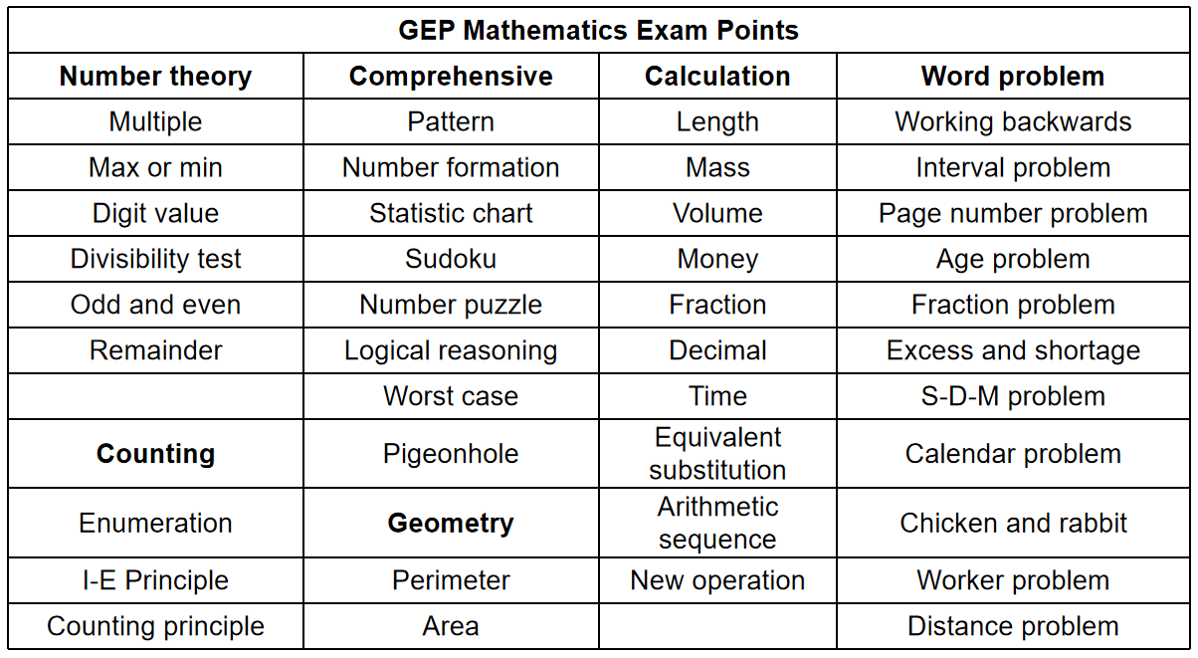
From the knowledge-points overview, a large portion of the examinable content sits inside “Word Problem”.
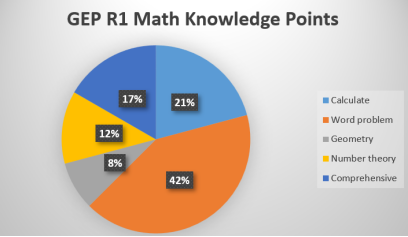
The pie chart makes it even clearer: Word Problems take up about 42% of the paper. In other words, if a student wants to score well in GEP, they must be consistently strong in word problems—not only to “pass a round,” but to compete for top marks.
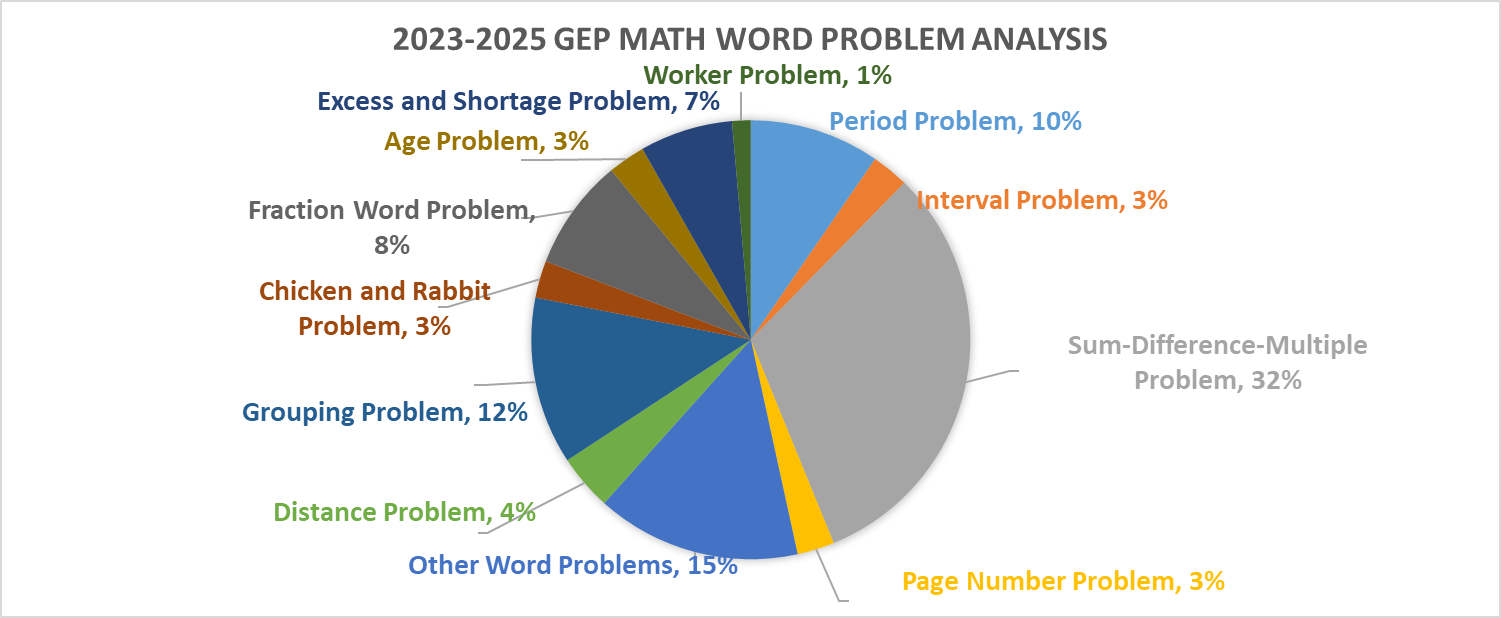
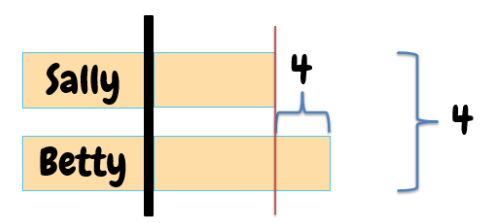
Over the past three years, the most frequent individual word-problem type is the Sum–Difference–Multiple (S-D-M) family (32%), followed by the Grouping Problem (12%). In this article, we will dive deeper into these two, and include the Age Problem because S-D-M questions often appear in an age setting. Finally, we will cover Excess and Shortage (7%)—not the most common, but often the hardest, and it has appeared as the final question for three consecutive years (2023–2025). S-D-M questions test whether students can identify the relationship between two quantities: The most reliable approach is: Draw a model (bar model), because the model turns words into visible “units.” Example 1: Sum–Difference Q(GEP 2024): Sally and Betty had $26 altogether. Sally has $4 less than Betty. How much money does Sally have? Draw Model: If we “remove” the extra $4 from the total: 26 − 4 = 22 → now it’s two equal parts. So one part = 22 ÷ 2 = 11. Therefore, Sally has $11.
Summary:
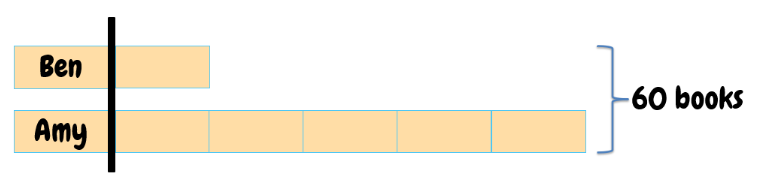
1. To solve the Sum-Difference problem, we draw a model. 2. Then, we remove the extra part to get 2 equal parts. 3. We divide by 2 to find 1 part. Example 2: Sum–MultipleQ(GEP 2024): Amy has 5 times as many books as Ben. They have a total of 60 books. How many books does Ben have? Draw Model (always draw the multiple first): Here, we will call the one bar that Ben has as 1 unit. So Amy has 5 units. In total, there will be 6 units. To find 1 unit: 60 ÷ 6 = 10 books Therefore, Ben has 10 books.
Summary:
1. Draw Model to solve Sum-Multiple Problem. 2. Draw from multiple (Ben has 1 unit, so Amy has 5 units) 3. Find 1 unit from Sum (Sum divided by number of units)
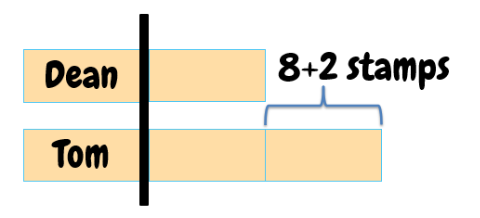
Example 3: Difference–Multiple (with a change)Q(2025): Dean has 8 stamps fewer than Tom. After Dean gave away 2 stamps, Tom has twice the amount of Dean. How many stamps does Dean have now? Key idea: draw the “after” situation because that’s when “twice” happens.
Originally Tom is 8 more; after Dean gives away 2, the gap becomes 8 + 2 = 10. Draw Model(After): So we have 1 unit of 10 stamps. Thus, the number of stamps Dean has is 10 now. Summary:
1. Draw Model to solve Difference-Multiple Problem.
2. Draw Multiple first.
3. Show Difference. Example 4: Exchange problems (sum never changes)Q(2025 Q39): A has 14 marbles, B has 13 marbles. How many marbles does B need to give to A so that A has two times as many as B? Important concept: When marbles move between A and B, the sum stays the same.
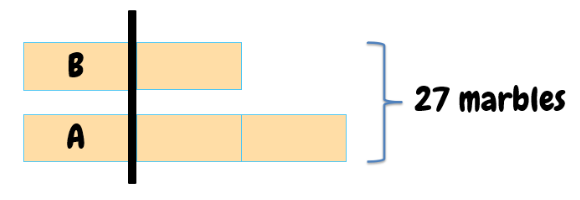
Sum = 14 + 13 = 27. Draw Model(When A is twice B): A has 2 units and B has 1 unit so in total we have 3 units, and their sum is 27. 1 unit: 27 ÷ 3 = 9 marbles. B went from 13 to 9, so B gave 4 marbles away. Summary:
1. Draw Model.
2. Draw Multiple First.
3. Find 1 unit from Sum.
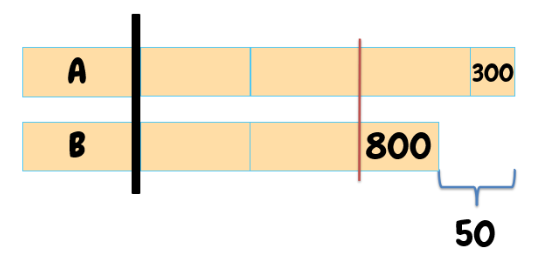
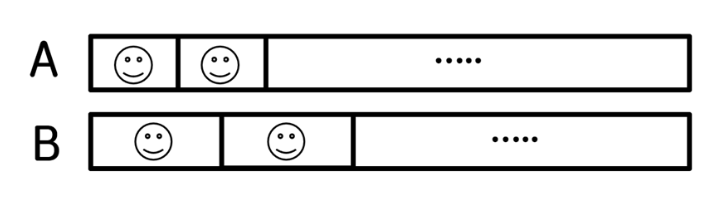
4. Remember to calculate the number of marbles that B originally had. These 4 examples are common types of SDM problems that have been examined in GEP. However, there are also some questions that are very difficult. Out of 24 S-D-M questions from 2023–2025, 20 are easy and 4 are hard → 83.33% are manageable if students master models and units. Let’s try to look at a harder S-D-M problem. A harder S-D-M example (multi-step comparison)Q(2023 GEP): Jug A can hold 50 ml more than jug B. Remember, we should draw multiple first. Here the multiple is represented as cups. Draw Model: From the model drawn, we can see that the difference between Jug A and B, is 850 (after the red line). So, one cup will be 800 + 50 - 300 = 550ml. S-D-M Summary: Draw Model Always draw the multiple first (units).
Add/mark the difference (more/less, before/after, exchanged amount).
Find 1 unit from sum or difference, then scale.
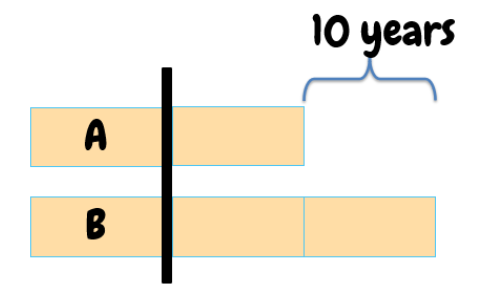
2.1) Age Problems (often disguised S-D-M)Sometimes, S-D-M problems will appear in the form of an Age Problem in GEP Math. The method is the same, Draw Model. However, there is one special characteristic that we need to know here about Age Problem. If A is 10 years old and B is 15 years old, the age difference is 5 years. After 8 years, A is 18 years old and B is 23 years old. The age difference will still be 5 years. This means that Age Difference does not change. So, let's look at a past year question: Example:
Q(2023): Ahmad is 10 years older than Tom. 2 years later, Ahmad will be twice as old as Tom. What are their ages now? Focus on “2 years later” (that’s where “twice” happens): So 1 unit = 10. Later: Tom = 10, Ahmad = 20. Now subtract 2 years to get “now”: Tom = 8, Ahmad = 18. Summary:
1. Draw the time point where the “times” relationship appears.
2. Use the unchanging age difference to find 1 unit. 3) Grouping Problems (12%)Grouping problems appear when there are two unknown quantities, and direct solving is messy—but the question contains a hidden “pairing/grouping relationship” that creates equal bundles. The method is: Find a small repeating equal relationship (e.g., 3 of A equals 2 of B).
Combine them into a group.
Use totals to count groups → then find each quantity.
Example 1 (Sticker strings)
Q(2025 GEP): String A uses 2 cm stickers, String B uses 3 cm stickers. There are 45 stickers in total, and the two strings have the same length. How long is one string? Here, we know the total stickers of A and B, and their length are the same.
Key observation:
Notice that 3 sticker A (3x2 = 6cm) is the same length as 2 sticker B (2x3 = 6cm). So we group 3 A and 2 B together to have 5 stickers. 45 ÷ 5 = 9 groups of 3 A and 2 B.
So A has 9×3 = 27 stickers → length = 27×2 = 54 cm.
(Or B has 9×2 = 18 stickers → length = 18×3 = 54 cm.)
✅ One string is 54 cm. Summary:
1. When we have 2 unknown numbers (number of stickers A and B are unknown).
2. Group based on the relationship of numbers. (Here we have the length of 3 sticker A = length of 2 sticker B) Example 2 (Coins)Q(2024 GEP): Mary has an equal number of 50¢ and $1 coins. She took half of her $1 coins away. In the end, she has $6 left. How much did she have at first? Now, we don't know the number of 50₵ and $1 coins, and we can't directly calculate, so we can use the grouping method. She took half of her $1 coins away, which means that the number of 50₵ coins is twice the number of $1 coins. Key observation:
Notice that the value of two 50¢ coins = one $1 coins, so group:
(two 50¢) + (one $1) = $2 per group $6 ÷ $2 = 3 groups
So remaining: 6×50¢ and 3×$1.
Originally, $1 coins were double (because she took half away): 6×$1.
Total at first = $3 (from six 50¢ coins) + $6 (from six $1 coins) = $9.
✅ She had $9 at first. Summary:
1. We don't know the number of 50₵ and $1 coins, and we can't directly calculate, so we use the grouping method.
2. Group based on the relationship of the numbers, here we have two 50₵ coins = one $1 coin. Grouping Summary:
1. Use grouping when you have two unknown counts.
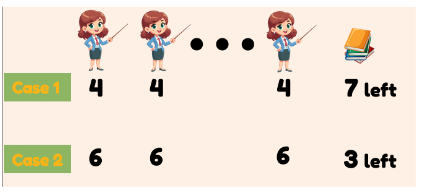
2. Group based on a relationship between two numbers. 5) Excess and Shortage Problems (7%) — low frequency, high difficultyAlthough Excess and Shortage problems are not the most common, they are often the hardest, and they have appeared as the final question for three straight years (2023–2025). The key feature of an Excess and Shortage problem is that we only know two distribution scenarios, but we do not know the total amount or how many shares/groups there are. When the distribution is insufficient, it is called a “shortage”; when there is leftover, it is called an “excess”. Usually, we solve it by comparing the change in the total with the change per group (Change in total vs. Change in single). Example 1 (Simple Example)Q: When each teacher receives 4 books, there are 7 books left over, and when each teacher receives 6 books, 3 more books are needed. How many teachers are there, and how many books are in the batch? We need to draw out both situations. First, we see that from case 1 to case 2, the number of books every single teacher receives changes by 2. So the change in single person is 2.
Next, we look at the change in total, 7 books left in case 1 to 3 books left in case 2, the change is 7 - 3 = 4. This means that we have 7 books and we distribute 2 books each to every teacher, and the total books distributed is 4. If each teacher receives 2 books, how many teachers receive 4 books?
2 teachers. To find the number of books, we can take 4 books x 2 teachers + 7 books left = 15 books or 6 books x 2 teachers + 3 books left = 15 books. Summary:
1. Special feature: 2 cases.
2. We look at both cases where each case has SAME number of people.
3. Change in total ÷ Change in single to get number of teacher.
Example 2 (Harder: two groups instead of two “cases”)Now, let’s look at a harder past year question
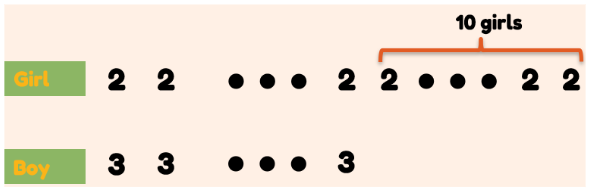
Q(2023 GEP R1 Q40): There are 10 more girls than boys. Each girl has 2 red balls. Each boy has 3 blue balls. The number of blue balls equals the number of red balls. How many boys are there? For this question, we see that we don't have 2 cases, but 2 genders, boy and girl. So, let's draw it out. Let's look at the change in single person first. From Case 1 to 2, each boy has one extra ball. So the change in a single person is 1.
Next, let's look at the change in total. Keep in mind that we must only look at the situation where there are same number of boys and girls. So, we can convert the 10 girls extra into 20 extra balls(10 girls x 2 balls = 20) Since the NUMBER of red balls and blue balls are the same, this means that the extra 20 balls must be distributed to each boy, with each boy receiving one blue ball. Hence, this means we have 20 boys. Thus, we have 30 girls.
That’s all for today’s sharing on the GEP word problem types. The questions mentioned in this article have also been compiled into the pdf below. Parents, please remember to let your children take a look! If you or your child have any questions, feel free to leave a comment anytime or contact me at +65 89168068, once I see it, I’ll reply right away!
GEP Word Problem Examples
| 


 发表于 2025-12-22 15:43:37