本帖最后由 Nora老师 于 2026-1-9 09:23 编辑
PSLE Classes Now Open | Kangaroo Study 2026 Semester 1 Enrollment Guide
The second half of fifth grade is the preparatory phase for the PSLE, while sixth grade is the period for comprehensive review and final sprint. Starting from sixth grade, students not only need to learn new content in school but also must review all the knowledge points from first to fifth grade, identifying and filling any gaps. Only after thoroughly reviewing and mastering these knowledge points can they smoothly tackle the challenging questions during the final three months of intensive preparation.
1. What knowledge points are tested in PSLE Mathematics?
The Kangaroo Study research department has analysed the test points of each question from the past three years. Based on the school syllabus, the test points are divided into 12 modules: Whole Numbers, Ratio, Fractions, Decimals, Rate and Speed, Algebra, Percentage, Measurement, Area and Volume, Geometry, Data Representation and Interpretation, and Data Analysis.
We have categorized all questions and question types from the past four years (2021–2024) according to these modules. Even after removing "Direction and Orientation" and "Speed, Time and Distance" from the 2026 syllabus, there are still 75 knowledge points tested.
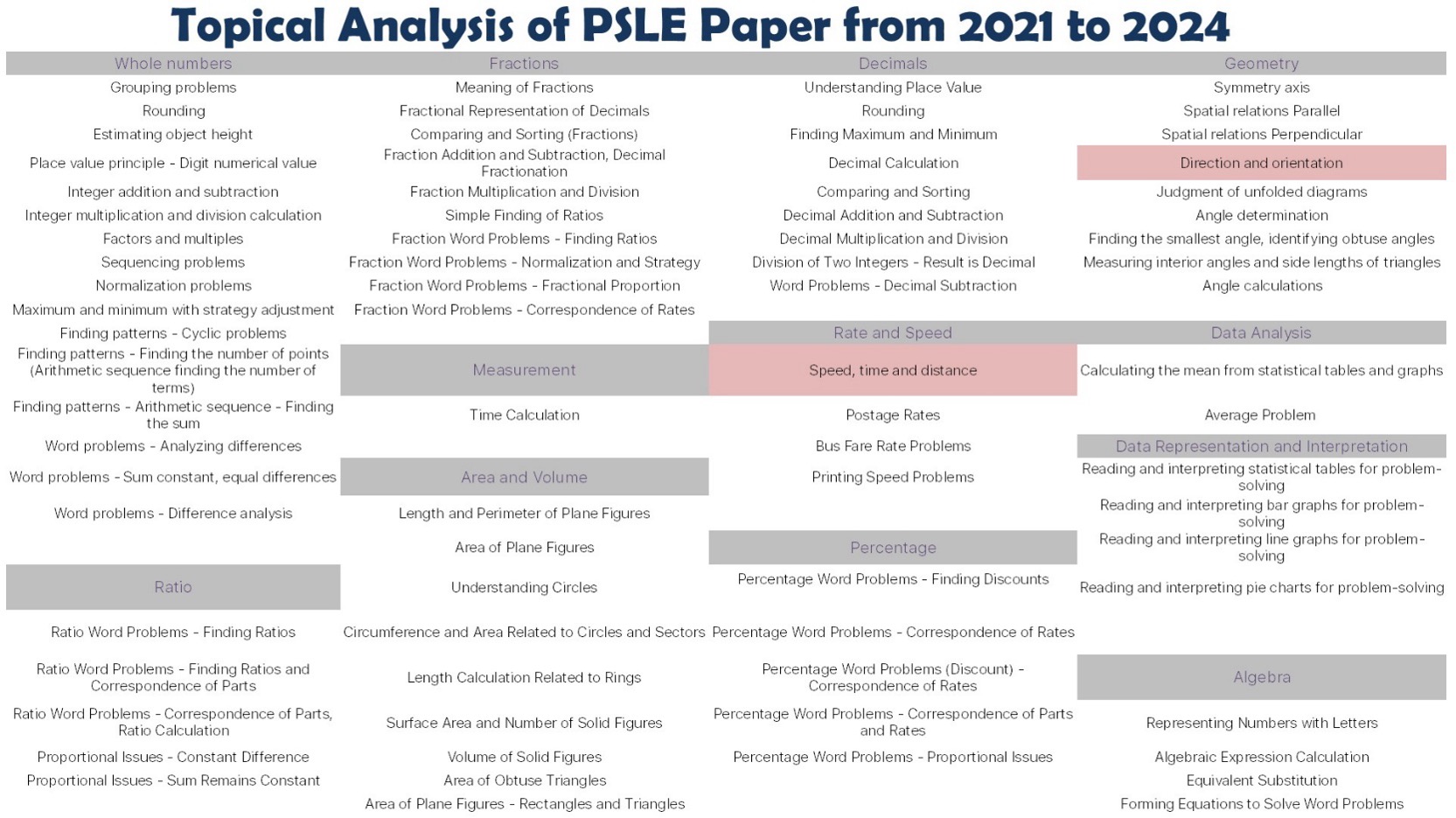
Among these 75 knowledge points, there are both simple foundational topics and more challenging ones that test advanced methods. After extracting the key and difficult points from Paper 2, we found that 32 of these knowledge points are particularly challenging.
2. Why is it increasingly difficult to achieve AL1 in PSLE Mathematics?
(1) Easy to Learn, Hard to Test—PSLE Mathematics is Causing Tears
In recent years, the PSLE examination has shown a distinct characteristic: the actual test difficulty exceeds the difficulty level of content covered in school.
Area and Volume is a key and challenging focus in the PSLE. Let's take the "Water Pouring Problem" as a detailed example.
The topic of water pouring problems is covered in dedicated chapters in both Primary 5 and Primary 6. But how deep does the school curriculum go?
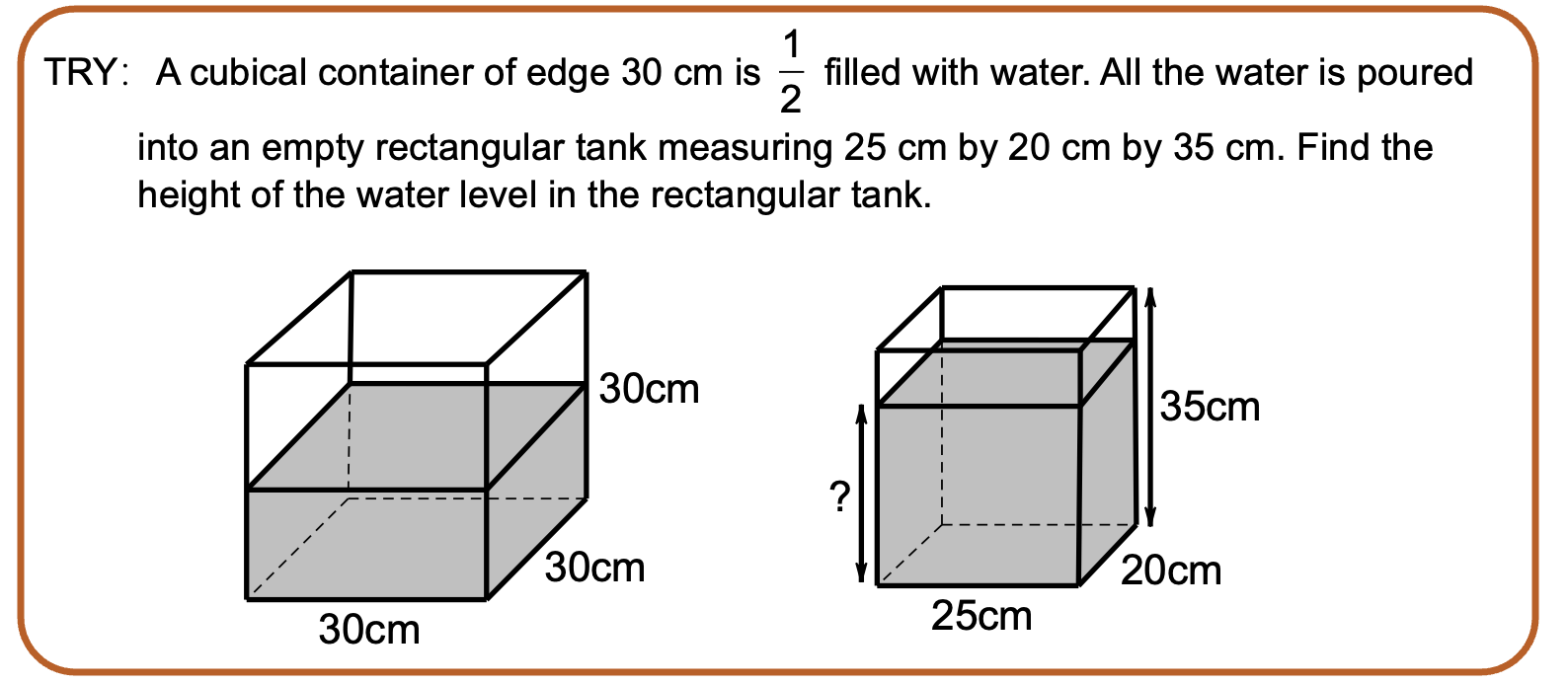
Below is a typical Primary 5 school-level question, which only tests the basic concept of volume calculation and is relatively straightforward.
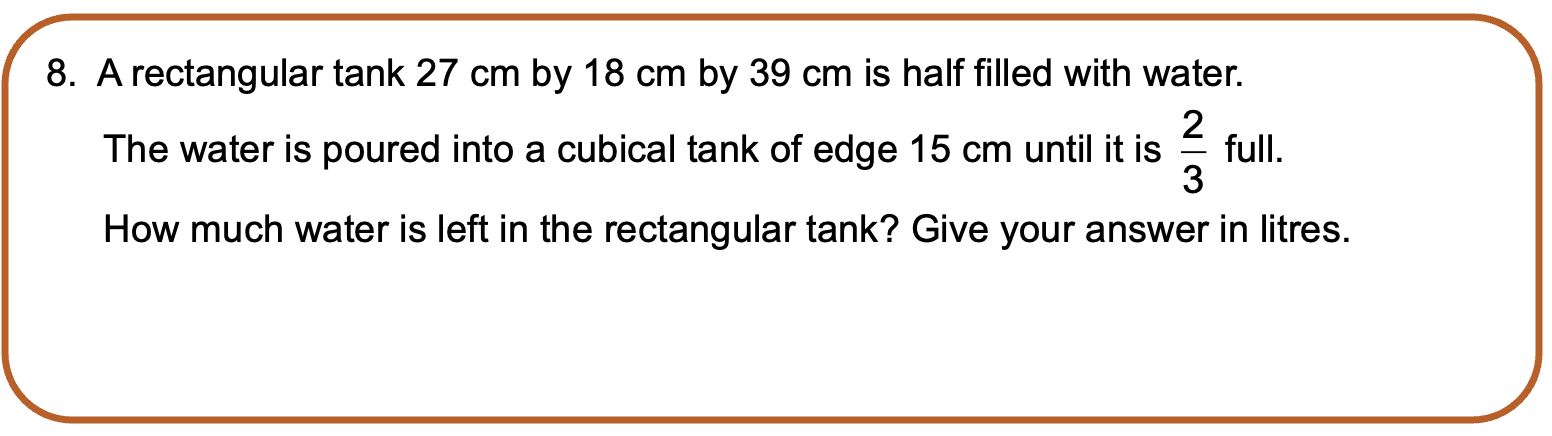
Here is a typical Primary 6 school-level question, which focuses on the reverse application of the volume formula—nothing more than that.
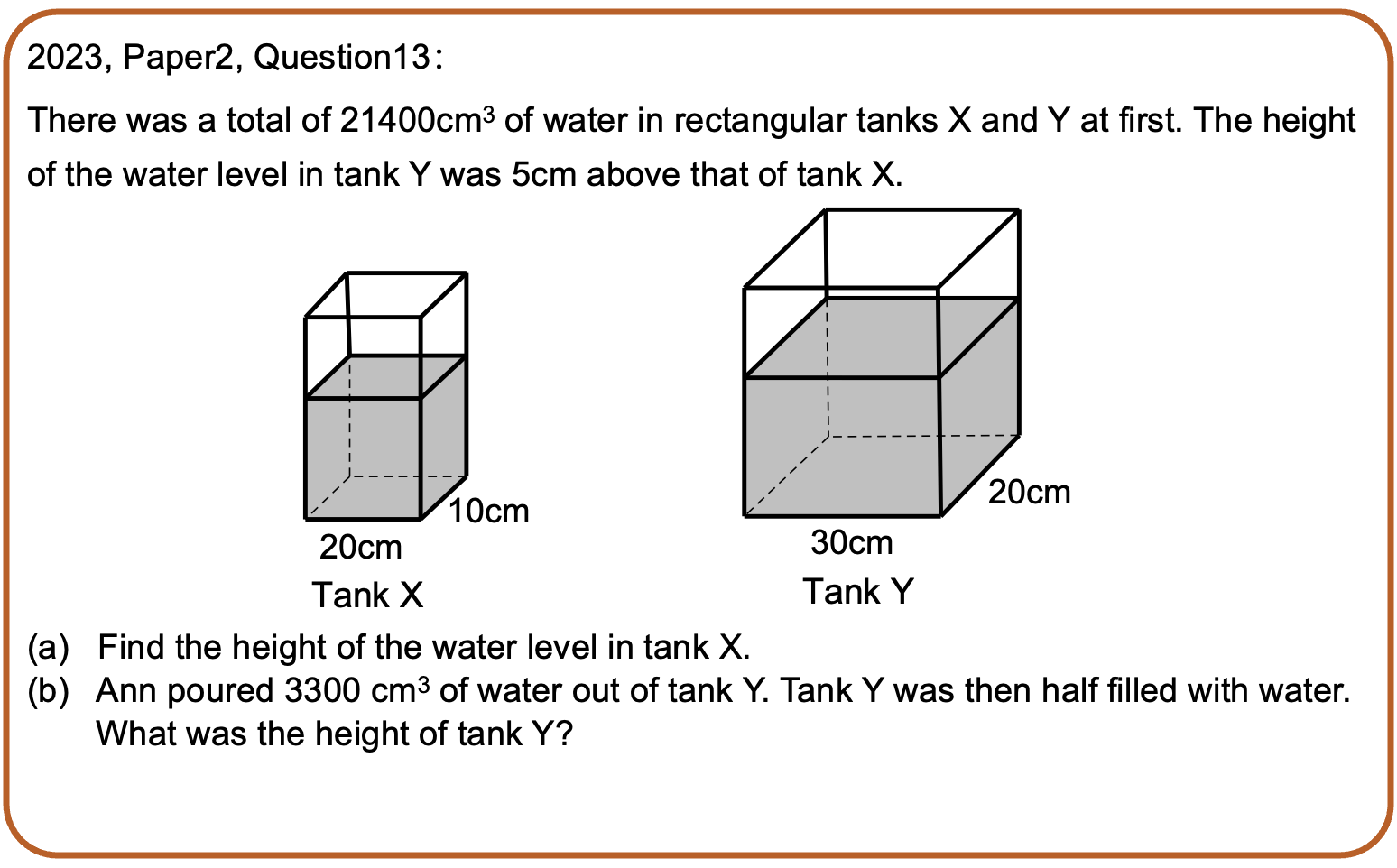
So, what does the Water Pouring Problem in the actual PSLE look like?
Compared to the single-knowledge-point assessments in school exams, this PSLE question is much more multi-faceted and integrated. Beyond applying the volume formula flexibly, students need to understand how to convert problems involving different heights into ones with the same height, and then how to quickly calculate heights under that condition. Since such holistic problems are rarely encountered in school, achieving a perfect score on them is quite challenging.
(2) Too many PSLE knowledge points, too little review time The timeline for the 2025 PSLE is as follows:

Under normal circumstances, students will finish learning all Primary 6 content by the end of May next year. June is the mid-year holiday, leaving the review period as July, August, and September—a total of 92 days. During this time, students have school in the mornings, some need to prepare for DSA written tests and interviews, and in addition, there are the PSLE Oral and Listening Comprehension exams in mid-August and mid-September. Even if we temporarily ignore the above factors like school and other exams, and calculate based on reviewing four subjects, the average review time per subject is: 92 ÷ 4 = 23 days. Taking Mathematics as an example, with its 12 modules, the review time per module becomes: 23 ÷ 12 ≈ 1.92 days. This time is certainly insufficient. 3. Kangaroo Study's PSLE Preparation System Kangaroo Study's PSLE preparation system addresses the two major challenges mentioned above through the following features:
(1) Extended difficulty in each module to ensure "learning is harder than the exam"
Based on our analysis of the actual PSLE papers from the past three years, we found that the modules emphasized in the challenging questions vary each year, indicating that the most difficult questions on the PSLE are quite flexible and unpredictable. To help students stay calm and perform well under exam conditions, we incorporate extended knowledge in every module. The depth and difficulty of our lessons exceed that of the actual PSLE questions, ensuring that students never face the problem of "learning is easy, but the exam is hard." This approach helps them secure full marks with ease during the exam. Below is an example of a Water Pouring Problem from our teaching materials last year.
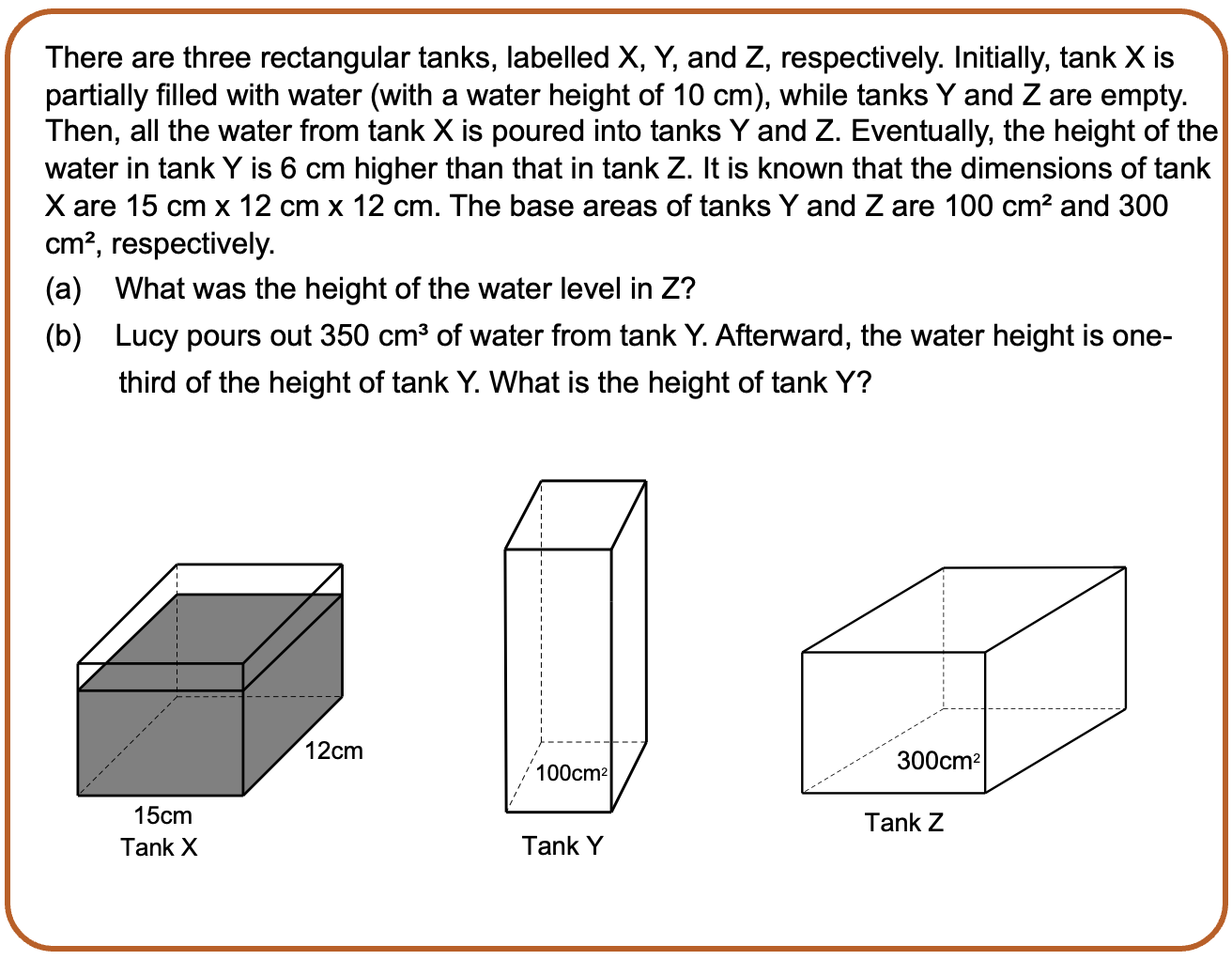
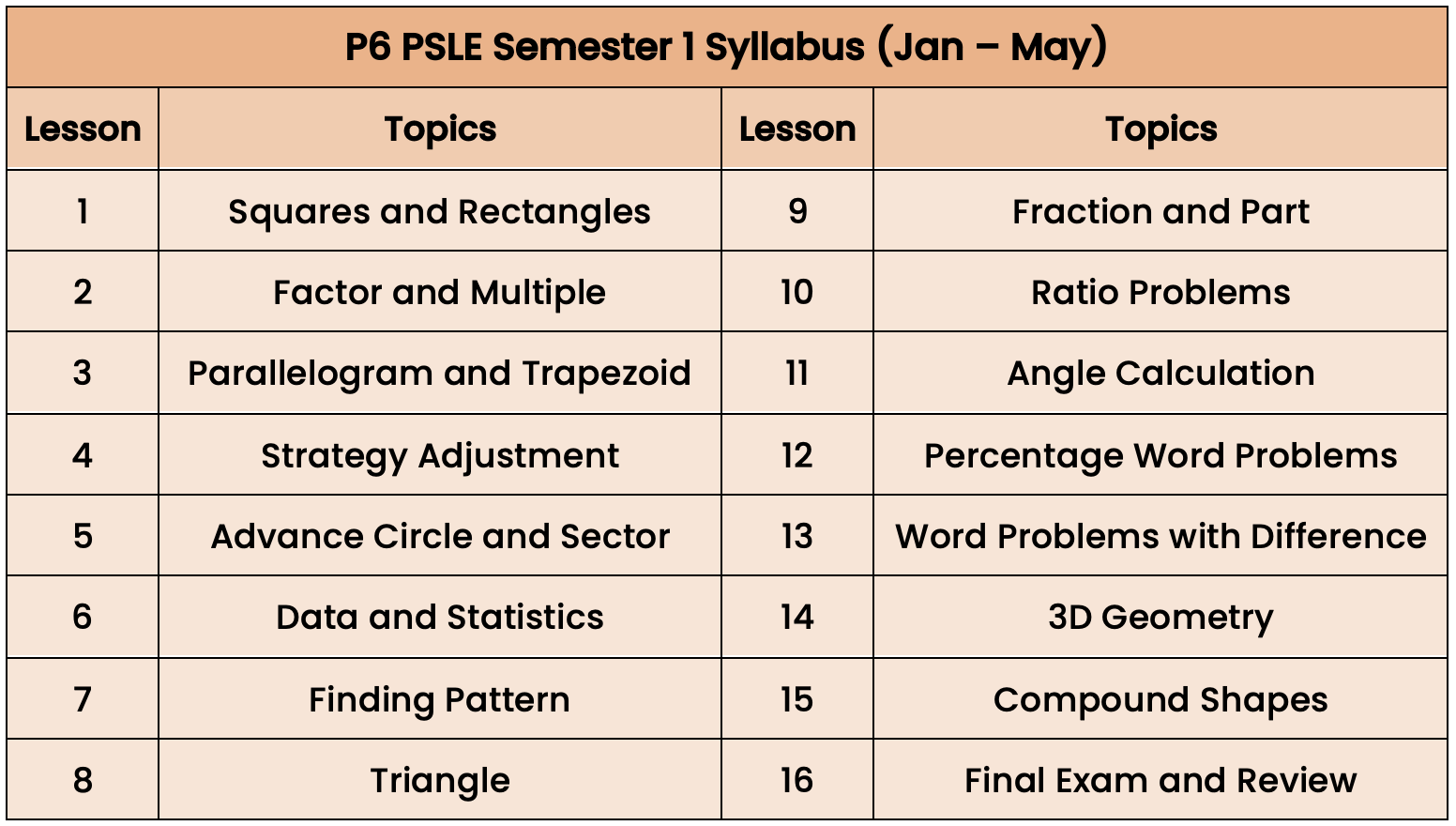
Interestingly, this exact type of problem appeared in this year's PSLE 2025 Mathematics exam. (2) Four-Stage Comprehensive Review for Efficient Preparation For math, scientific study planning involves two rounds of review after completing P6 PSLE knowledge points (9 chapters), including all knowledge points (22 chapters), focused review on key points (6 chapters), and four mock exams. Our four-stage comprehensive learning plan helps students achieve AL1. a.Solving High-Frequency P6 Key Points Early During the critical period at the end of Primary 5 (Term 4), Kangaroo Study's PSLE system helps students tackle high-frequency P6 key points early, laying a solid foundation for comprehensive review in P6 Term 1. For example, in End of year term, Lesson 2 and Lesson 3 and 5 will cover advanced fraction ratio & percentage problems. Lesson 4 will discuss circles and sectors, Lesson 6 will teach how to represent numbers with letters, Lesson 7 will focus on the compound shapes, and Lesson 9 will study 3-D Geometry. During this holiday, we will complete the high-frequency PSLE key points in advance, clearing the obstacles for comprehensive review and sprinting in Primary 6. b.Comprehensive Review In the first half of Primary 6 and the mid-year holiday, we conduct a comprehensive "carpet" review based on the analysis of 470 past questions over the past ten years, summarized into 12 modules and 60 review points, with deep extension for each point. c.Tacking Difficult Points After undergoing the comprehensive review phase, achieving full marks in Paper 1 is generally no longer an issue. The next step is to tackle the difficult points in Paper 2. According to our analysis of the proportion of each module's scores in Paper 2 over the past three years, we know that Area and Volume account for 29.1%, Percentage accounts for 25%, and Geometry accounts for 14.5%, making them the three main obstacles in the PSLE exam. Two months before the exam, we will enter the "obstacle run" phase, where we will review and organize the challenging and key question types. This will help students become familiar with the characteristics of difficult questions and the methods to solve them, laying a solid foundation for achieving full marks in Paper 2. d.Mock Exam Stage After comprehensive review and tackling difficult points, it is necessary to thoroughly check and strengthen students' exam skills and habits. The research department will set the number and difficulty of questions according to the module score proportions in the real exam. After each exam, personalized test paper analysis will be conducted to ensure nothing is overlooked in achieving AL1. Curriculumn Plan of 2026 PSLE

4. Introduction of the Teacher

Tr. Ma Zhangchi
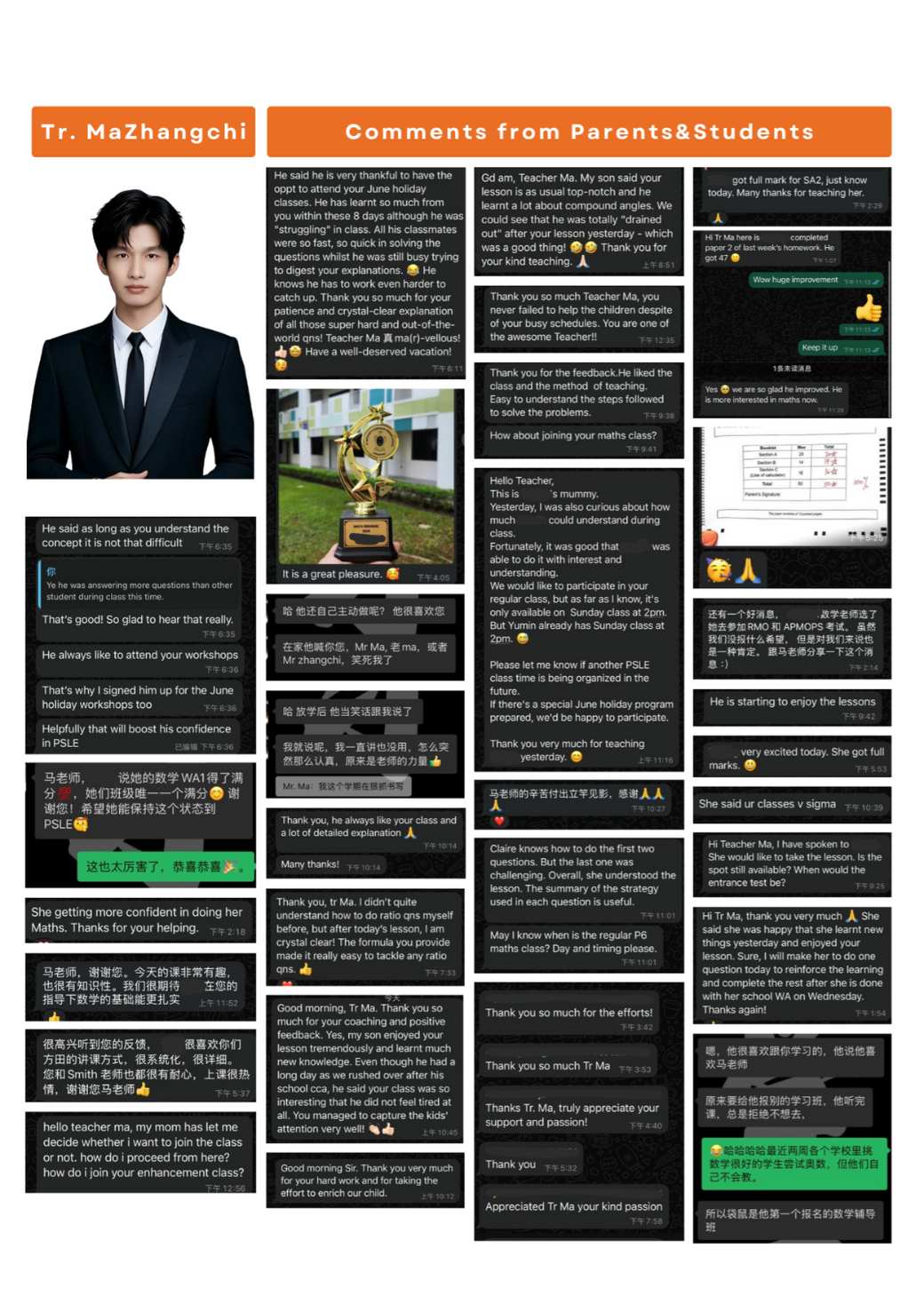
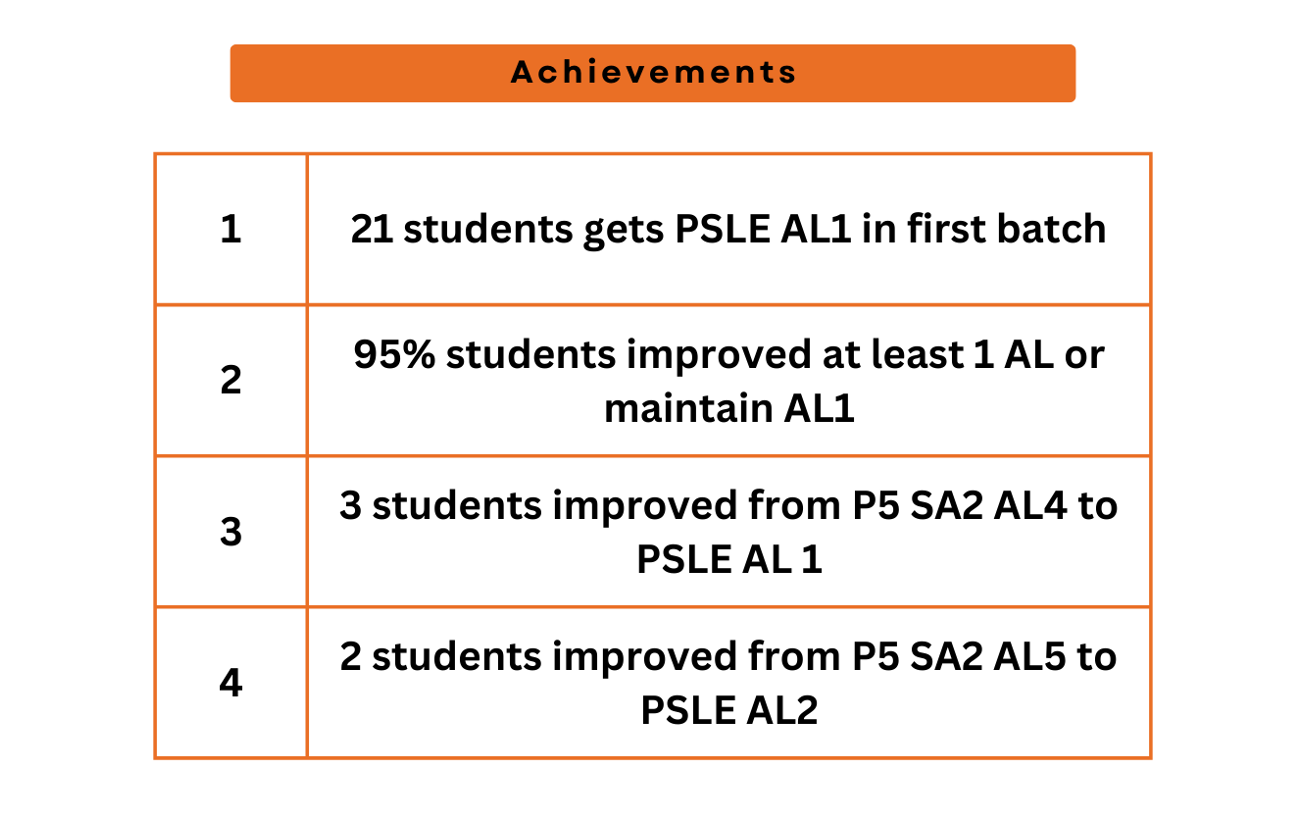
Head of the P6 PSLE Department at Kangaroo Study, Teacher Ma is the architect behind the current P5 and P6 PSLE syllabus and teaching materials. Recognized as the fastest-growing teacher in the organization, he combines academic excellence with a passion for nurturing student success. A Computer Science graduate from Murdoch University, Teacher Ma’s foundation in mathematics was forged early—he was a Math Olympiad competitor and multiple first-place awardee during his primary school years. Born into a family of math educators, he began honing his teaching skills as a teaching assistant during his university days.
5. Introduction to the Teaching Model (1) Three Key Features Parental Observation: Each enrolled student may be accompanied by one parent who can sit in on the class. Parents may observe their child's engagement, understand the course content and pace, take notes, etc., provided they do not disrupt the classroom order. Flexible Refund Policy: Tuition fees can be refunded proportionally at any point during the course. Dual-Teacher Classroom: Each class features one Lead Teacher and one Teaching Assistant (TA). While the Lead Teacher conducts the lesson, the TA monitors student learning, provides feedback, and manages real-time class streaming. (2) The Seven-Step Teaching Method Kangaroo Study implements the "Seven-Step Teaching Method" to safeguard learning outcomes and cultivate good study habits in students. The steps are: Pre-class Quiz, In-class Instruction, Error Correction, Live Class Streaming, Post-class Quiz, Homework Consolidation, and Course Summary.
6. Registration Information
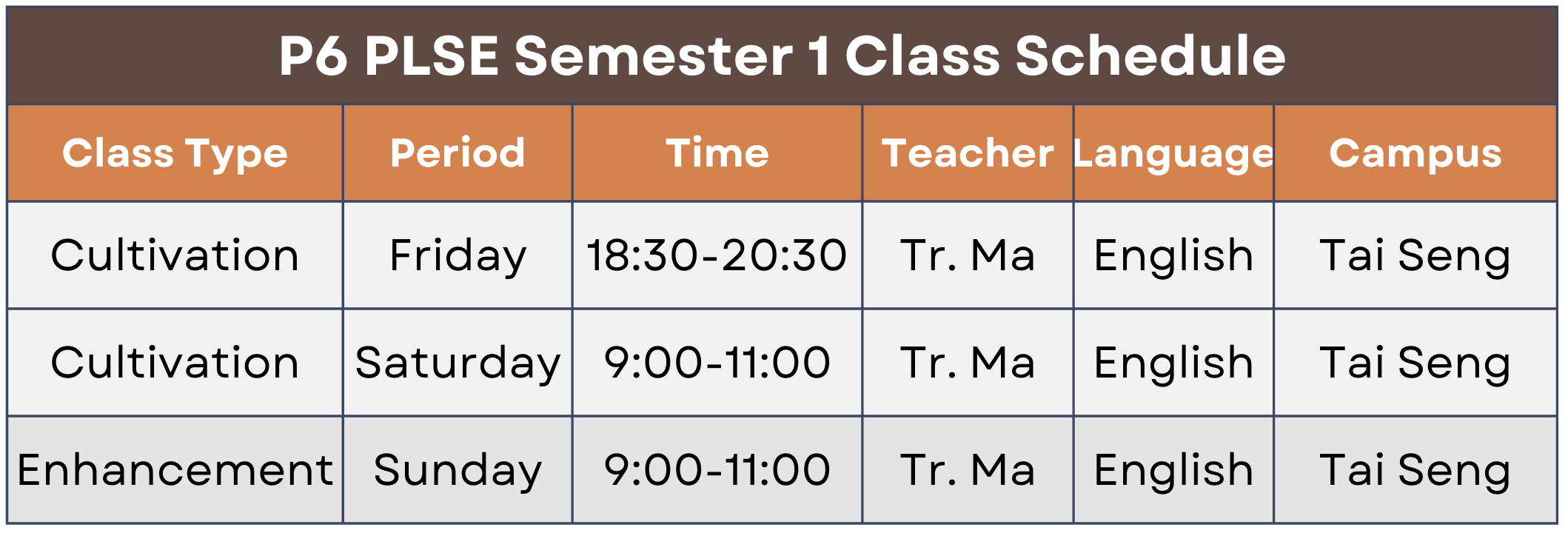
(1) Format: In-person, face-to-face classes.
(2) Location: #02-12, Grantral Mall, 601 MacPherson Road, Singapore 368242.
(3) Class Size Limit: 16 students.
(4) Course Fees: $120 per session. The Semester 1 course comprises 16 sessions, totalling $1,920 (No registration fee, no deposit, no textbook fees).
7. Other Information
The admission test is not just an entrance test but also a check on the essential knowledge points for P5 PSLE. Students aiming for AL1 next year can come for the test. After the test, teachers will provide free explanations and one-on-one test diagnostics. Students who have previously tested for Olympiad courses are also welcome to take the test.
Test location:#02-12, GrantralMall, 601MacPherson Road, 368242
Contact Tr. Ma to book an entrance test.

| 


 发表于 2026-1-8 20:20:46